
Why Common Voice Isn't Enough for Commercial African Language AI
Common Voice is a remarkable open-source corpus - but its license and coverage make it unsafe to ship in commercial African language products. Here's the commercially licensed alternative.
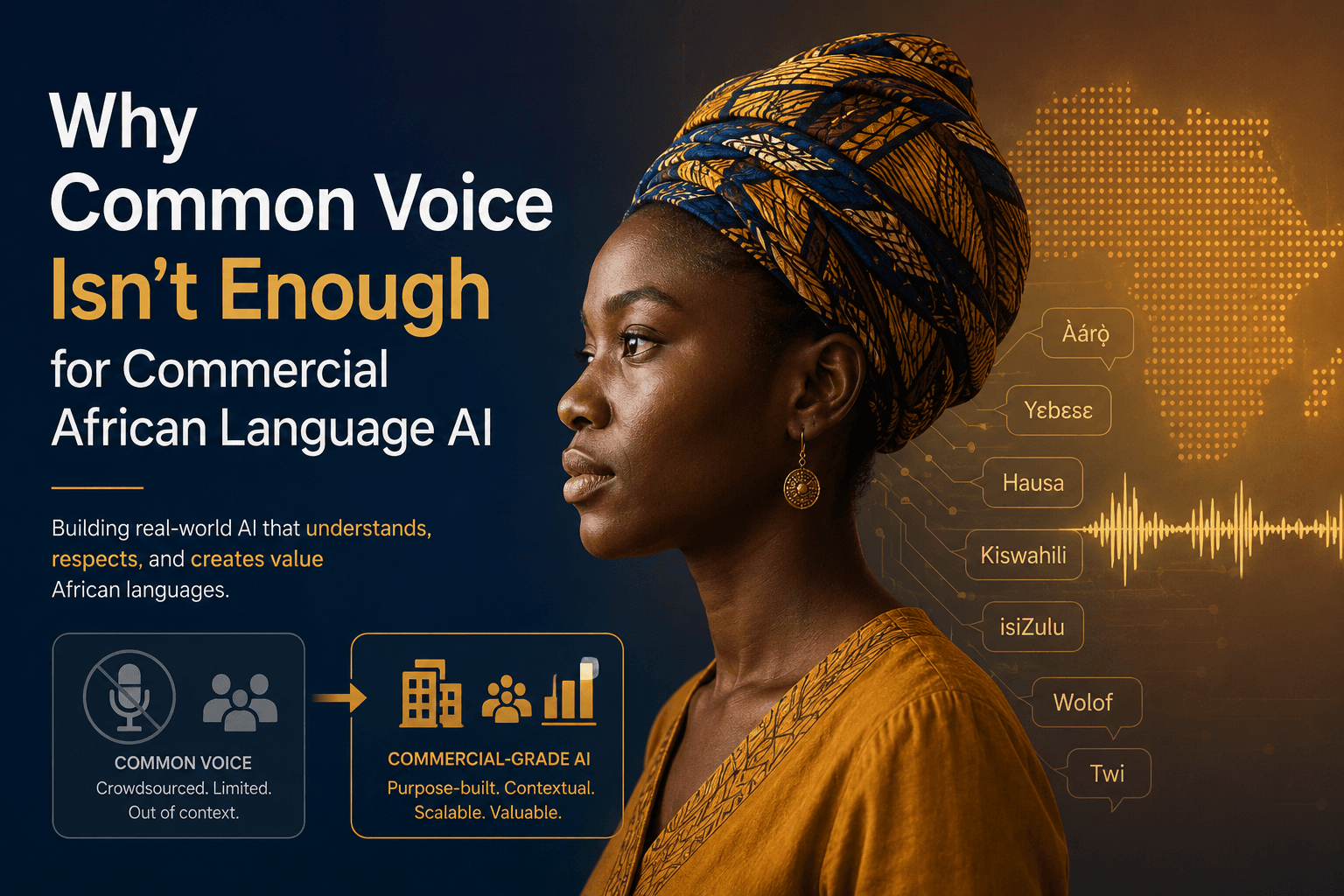
If you're building an AI product that understands Twi, Wolof, Yoruba, or any other African language, you've almost certainly encountered Mozilla's Common Voice. It's the largest open-source multilingual speech corpus in the world. It's free. It's well-documented. And on the surface, it looks like exactly what you need.
It isn't. Not for commercial products. Not in West Africa. Not yet.
This article explains why and what a commercially viable alternative looks like.
What Common Voice gets right
Let's give credit where it's due. Common Voice is a genuine technical achievement. As of 2024, it covers over 100 languages, has collected millions of hours of audio from volunteer contributors worldwide, and has accelerated speech research in dozens of languages that global vendors like Appen and Scale AI have historically ignored.
For academic research, prototyping, and open-source projects, it is extraordinary. If you're a PhD student studying Swahili phonology or a developer building a hobby project, Common Voice is the right starting point.
The problems begin the moment you try to ship a commercial product.
Problem 1: The license is not commercially safe
Common Voice data is released under the CC0 Public Domain Dedication. At first glance, this sounds ideal public domain means no restrictions, right?
Not quite. CC0 waives the licensor's rights, but it cannot waive rights held by third parties. In practice, this creates three real legal risks for commercial deployments:
Speaker consent ambiguity. Common Voice contributors donate their voice under Mozilla's contributor agreement. That agreement is designed for open research use. It was not designed with commercial SLA-backed products in mind particularly products that will be used in regulated industries like financial services IVR, healthcare voice bots, or government citizen services. If a contributor later disputes the commercial use of their voice data, you are exposed.
No indemnification. When you license data from a commercial vendor, you typically receive an indemnification clause the vendor takes legal responsibility if the data causes intellectual property disputes. With CC0 data, you have no such protection. Your legal team is on their own.
Regulatory grey zones in West Africa. Ghana's Data Protection Act and Senegal's personal data protection law (Law No. 2008-12) both impose obligations on how biometric and personal data which voice recordings qualify as are collected, stored, and used commercially. Common Voice's contributor consent flow was not designed to satisfy these specific regulatory frameworks.
If your product is going to be deployed at scale an IVR system handling thousands of calls a day, a voice bot embedded in a banking app your legal and compliance teams will not sign off on CC0 voice data. They will ask for a commercial license with explicit speaker consent, clear data provenance, and ideally an SLA.
Problem 2: African language coverage is thin and uneven
Common Voice's African language coverage looks impressive on a map. In practice, the validated hours tell a different story.
As of early 2024, validated audio hours for key West African languages were critically low:
| Language | Validated Hours (approx.) | Status |
|---|---|---|
| Twi (Akan) | < 5 hours | Insufficient for ASR fine-tuning |
| Wolof | < 10 hours | Insufficient for production IVR |
| Yoruba | ~15 hours | Marginal for production use |
| Hausa | ~20 hours | Approaching usable threshold |
For context: fine-tuning a model like OpenAI Whisper or Meta MMS to production-grade accuracy for a specific language and domain typically requires a minimum of 50–100 hours of clean, in-domain audio. For IVR systems where the model must handle telephone-quality audio, background noise, and domain-specific vocabulary you need even more.
The Twi and Wolof datasets in Common Voice are simply too small to train a production ASR model. You can prototype with them. You cannot ship with them.
Problem 3: The data doesn't reflect how people actually speak
This is the subtlest problem, and the most damaging one for West African CPaaS deployments.
Common Voice collects audio by asking contributors to read pre-written sentences aloud. This produces clean, formal, slow speech the kind of speech that is easy to transcribe but deeply unrepresentative of how people actually talk.
In West African contexts, real conversation involves:
- Code-switching seamlessly mixing Twi with English mid-sentence, or Wolof with French. This is not an edge case. It is the norm in urban Ghana and Senegal.
- Tonal variation Twi is a tonal language where pitch changes meaning. Formal reading flattens tonal patterns in ways that informal speech does not.
- Domain-specific vocabulary a caller to a mobile money IVR says "me pε sika transfer" (I want to transfer money), not the kind of constructed sentence a script writer would produce.
When you train an ASR model on read-speech data and deploy it against natural conversational speech, accuracy drops dramatically. Your IVR system will misunderstand your users. Your voice bot will fail at the worst possible moments.
This is not a criticism of Common Voice's methodology it is an inherent limitation of volunteer-contributed read-speech data at scale. Solving it requires a fundamentally different collection approach.
Problem 4: No SLA, no support, no delivery pipeline
Common Voice is a dataset, not a data service. When you download it, you get a static archive. There is no:
- SLA guaranteeing data freshness or quality thresholds
- API for programmatic access or incremental updates
- Support channel for questions about annotation methodology
- Commitment to expand coverage in the languages you need
- Contractual relationship of any kind
For a startup or enterprise building a production CPaaS product, this matters. You need a vendor relationship someone you can hold accountable, escalate to, and rely on when your IVR launch is three weeks away.
What a commercially viable alternative looks like
The gap Common Voice leaves is not a gap in volume it's a gap in commercial safety, linguistic accuracy, and delivery infrastructure. A viable alternative for West African CPaaS deployments needs to satisfy all three.
Here is what that looks like in practice:
Commercial licensing with explicit speaker consent. Every speaker in the dataset must have consented to commercial use, with documentation that satisfies local data protection frameworks. The dataset must come with a commercial license that includes indemnification.
Natural speech collection, not read-speech. The collection methodology must capture how people actually speak including code-switching, tonal variation, and domain-relevant vocabulary. Image-prompted elicitation, where speakers describe what they see rather than reading a script, has been shown to produce significantly more natural and linguistically varied audio than read-speech approaches.
AI quality filtering at capture. Mobile collection environments are noisy. Audio must be filtered for signal quality automatically at the point of capture before it reaches human reviewers to ensure the dataset doesn't require manual noise-cleaning on the buyer's side.
Linguistic quality assurance with measurable standards. Inter-annotator agreement (IAA) above 80% across all annotations is the industry benchmark for production-grade datasets. Any vendor should be able to produce this metric on request.
Delivery infrastructure. Data should be deliverable via API or S3 bucket, in the format your pipeline expects (WAV, 16kHz, mono is the standard for ASR fine-tuning), with an SLA on delivery timelines.
SLA-backed volume commitments. If you need 100 hours of Twi audio by a specific date, your vendor should be able to commit to that contractually not leave you hoping a volunteer community will contribute enough.
The commercially licensed alternative for Twi and Wolof
Afriklang was built to close this gap. We are a West African speech data infrastructure company with a validated pipeline for collecting, annotating, and delivering commercially licensed African language audio datasets.
Our current catalogue includes:
- Twi (Akan) 50+ hours of speaker-verified audio, image-prompted elicitation, commercially licensed, WAV 16kHz mono
- Wolof 50+ hours, same pipeline and standards
Our pipeline combines a gamified mobile-first collection app (native speakers earn points for contributing audio), AI noise-filtering at capture, and human linguistic review with IAA targets above 80% overseen by our Linguistic Lead and a trained reviewer network.
Every dataset we sell comes with a commercial license, data provenance documentation, and SLA-backed delivery via API or S3.
Yoruba, Hausa, Amharic, and Swahili are in our roadmap. If you need a language not yet in our catalogue, get in touch we build on demand for enterprise partners.
The bottom line
Common Voice is a landmark contribution to open speech research. It has done more for low-resource language NLP than any other single initiative in history.
But if you are building a commercial product an IVR system for a Ghanaian bank, a voice bot for a Senegalese telecoms operator, an ASR model for a West African CPaaS platform Common Voice will not get you to production. The license is legally fragile, the African language coverage is too thin, the read-speech data doesn't reflect natural conversation, and there is no vendor relationship to support your launch.
You need commercially licensed, naturally collected, SLA-backed data from a vendor who understands the languages, the markets, and the compliance requirements.
That is what we built.
Want to evaluate our Twi or Wolof datasets before committing? Request a free data sample we'll send you a representative audio package with annotation samples within 48 hours.