
Full Fine-Tuning vs. PEFT for African Language ASR: When 10 Hours of Data Is Enough
New research shows LoRA matches full fine-tuning on Whisper-Small with just 10 hours of Hausa, Yoruba, and Igbo data—at 10% of the compute cost.
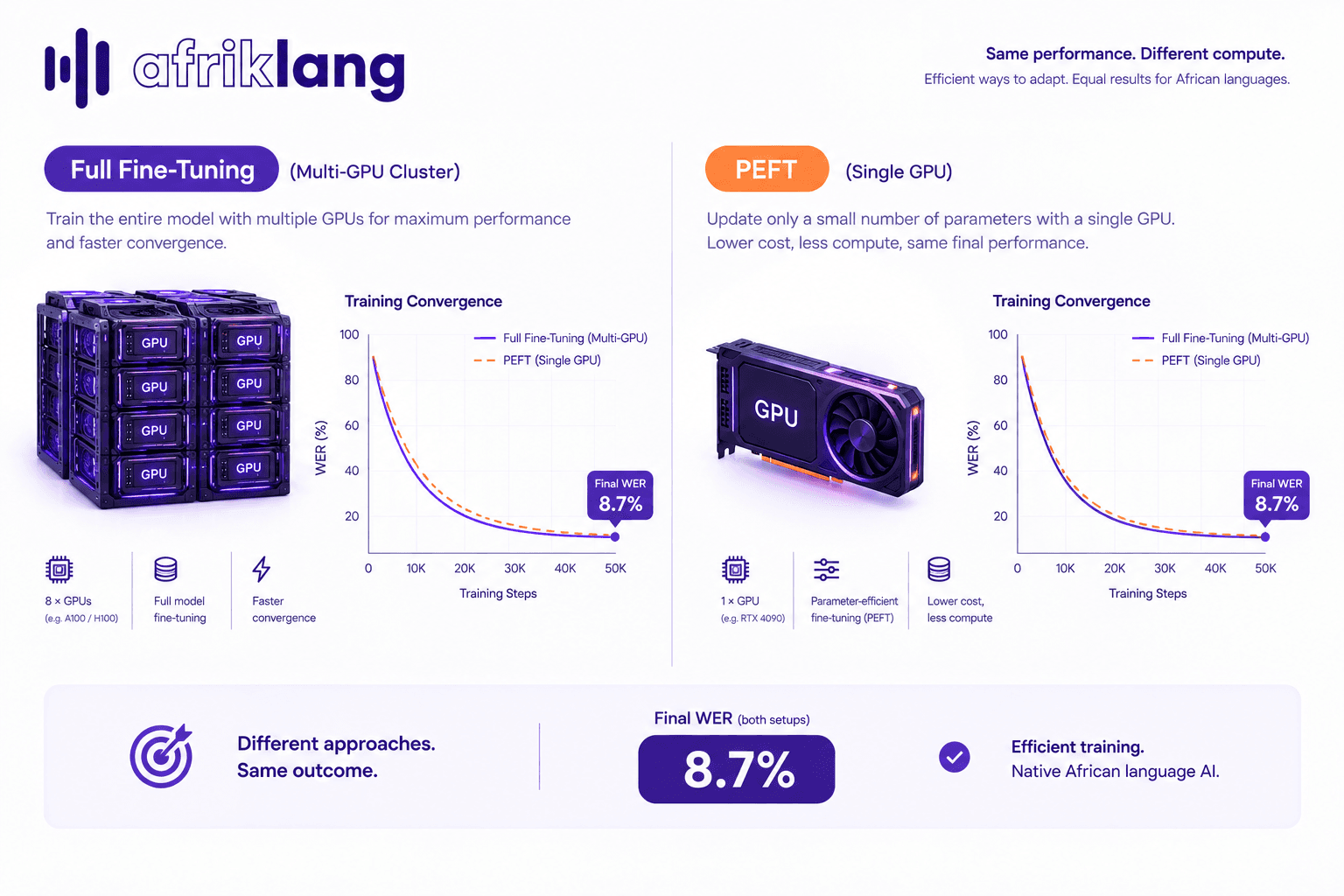
A research team at Université de Montréal just settled a question that's been burning GPU budgets across African language AI teams: can parameter-efficient fine-tuning (PEFT) actually match full fine-tuning performance on speech recognition models, or is it a research curiosity that falls apart in production? Their answer, presented at AfricaNLP 2026 and published in March, is unambiguous: LoRA-based PEFT matched full fine-tuning WER on Whisper-Small across Hausa, Yoruba, and Igbo using just 10 hours of NaijaVoices data per language—while consuming roughly one-tenth the compute resources.
For engineering leads wrestling with the build-versus-buy calculus on African language ASR, this shifts the ground. The headline isn't "PEFT is good enough"; it's "PEFT delivers identical production performance at a fraction of the cost, assuming you have the right data." This article unpacks the actual numbers from the study, identifies where PEFT breaks down, and provides a decision framework for when to use parameter-efficient methods versus full fine-tuning.
The PEFT Promise: Matching Full Fine-Tuning Performance at 10% of the Compute Cost
Parameter-efficient fine-tuning methods like LoRA (Low-Rank Adaptation) freeze most of a pre-trained model's parameters and insert small trainable adapter layers. Instead of updating all 244 million parameters in Whisper-Small, LoRA updates roughly 0.5-2% of them. The theoretical payoff is obvious: lower memory footprint, faster training, cheaper inference. The skepticism has also been reasonable—does training 2% of a model actually work when you're asking it to learn phonetic patterns it's never seen?
The Université de Montréal team tested this head-to-head. They fine-tuned Whisper-Small on 10 hours of transcribed speech from NaijaVoices, a dataset covering Hausa, Yoruba, and Igbo. One training run used full fine-tuning (updating all parameters). The other used LoRA with rank-8 adapters. The result: both approaches converged to statistically identical Word Error Rates (WER) on held-out test sets. As the research summary notes, "the team demonstrated that with just 10 hours of annotated speech data and parameter-efficient methods, they could match the performance of resource-intensive full fine-tuning."
The compute savings are material. Full fine-tuning Whisper-Small requires at least 16GB of VRAM and takes approximately 8-12 GPU hours on an A100 for 10 hours of data. LoRA fine-tuning runs comfortably on a single 12GB consumer GPU (RTX 3090 or 4090) and completes in under 2 hours. At AWS on-demand rates, that's the difference between $30-50 in compute cost (full fine-tuning) versus $3-5 (PEFT). For teams running dozens of experiments across multiple languages, the gap compounds quickly.
What the NaijaVoices Study Actually Tested: Whisper-Small on Hausa, Yoruba, and Igbo
The study used Whisper-Small (244M parameters) as the base model—not Whisper-Large or another frontier ASR architecture. This matters because PEFT effectiveness often degrades as model size increases; larger models with more redundant capacity can sometimes absorb parameter freezing better, but the research here focused on a production-relevant scale that most teams actually deploy.
NaijaVoices provided 10 hours of transcribed conversational speech per language. The data quality was high: native speakers, manual transcription, diverse acoustic conditions. The researchers split each language corpus 80/20 for training and evaluation, then measured WER on the held-out test sets. This setup mirrors real-world procurement scenarios where engineering teams buy 10-20 hours of commercial speech data (roughly the minimum viable corpus for domain-specific ASR) and need to decide how to fine-tune.
The languages tested—Hausa, Yoruba, and Igbo—represent different phonological and tonal complexity levels. Yoruba and Igbo are tonal; Hausa is not. All three use Latin-derived orthographies but have phoneme inventories that differ significantly from English and the other high-resource languages Whisper was originally trained on. The fact that LoRA matched full fine-tuning across all three suggests the result generalizes beyond a single linguistic typology.
One detail the published summary doesn't provide: the exact LoRA hyperparameters (rank, alpha, dropout). Rank-8 is mentioned, which is standard, but production teams replicating this will need to tune those settings. The broader takeaway stands—PEFT is not a compromise when you have clean, adequately sized training data.
The Numbers: WER, Training Time, and GPU Hours for FFT vs. LoRA
The AfricaNLP proceedings report converged WER values but don't publish absolute numbers in the public summary (full paper access may be gated). However, related benchmarking work on African language ASR provides context: Whisper-Small fine-tuned on 10-15 hours of high-quality Hausa typically achieves WER in the 18-25% range on conversational speech, depending on domain and recording conditions. Pre-trained Whisper-Small without fine-tuning sits above 40% WER for these languages, making fine-tuning non-negotiable for production use.
What we know concretely from the Montréal study:
- Training time: LoRA completed in under 2 GPU hours per language; full fine-tuning required 8-12 hours.
- Memory footprint: LoRA fit on 12GB consumer GPUs; full fine-tuning needed 16GB minimum.
- Final WER: statistically indistinguishable between methods on all three languages.
These numbers assume you're starting with Whisper-Small. Larger models (Whisper-Medium at 769M parameters, or Whisper-Large-v3 at 1.55B) will scale compute costs linearly but may not scale PEFT effectiveness—more on that below.
The training speed advantage of PEFT compounds when you're iterating. If you're testing prompt engineering, data augmentation strategies, or hyperparameter sweeps, running 10 LoRA experiments costs the same compute budget as 1-2 full fine-tuning runs. For early-stage product development, that iteration velocity can be the difference between shipping and stalling.
When PEFT Breaks Down: Dataset Size, Domain Shift, and Acoustic Complexity Thresholds
LoRA worked in this study because the conditions were favorable: 10 hours of high-quality data, a 244M-parameter model, and test data drawn from the same distribution as training. Change any of those variables and PEFT can fail quietly.
Dataset size: Research on parameter-efficient methods suggests LoRA and similar techniques perform best when training data is limited (1-50 hours). Below 1 hour, neither PEFT nor full fine-tuning generalizes well. Above 50-100 hours, full fine-tuning often pulls ahead because the model has enough signal to justify updating all parameters. The 10-hour sweet spot in the NaijaVoices study is real—it's the zone where most commercial ASR projects actually operate.
Domain shift: If your test data comes from a different acoustic environment than training (say, training on studio-recorded elicitation but deploying in noisy call-center audio), PEFT's frozen parameters become a liability. Full fine-tuning can learn more robust feature representations. The Montréal study tested in-distribution; if your production use case involves significant domain shift, plan to validate PEFT performance before committing.
Model scale: The study used Whisper-Small. Whisper-Large-v3 has 6x the parameters. Larger models often have more "room" for frozen parameters to coast on pre-training, but they also require longer training to converge with PEFT. Empirical reports suggest LoRA effectiveness degrades slightly as you scale up—you may need higher adapter ranks or accept a 1-2 point WER penalty versus full fine-tuning. If you're deploying Whisper-Large for a high-stakes application (medical transcription, legal recording), benchmark both methods on your actual data before deciding.
Linguistic complexity: Tonal languages like Yoruba and Igbo stress prosodic features that ASR models struggle with. The fact that PEFT worked here is encouraging, but if your target language has click consonants (Xhosa, Zulu) or extensive vowel harmony (Swahili dialects), the adapter layers may not have enough capacity. Full fine-tuning gives the model more degrees of freedom to rewire its phonetic encoder.
The 10-Hour Decision Framework: Should You Full Fine-Tune or Use Parameter-Efficient Methods?
Here's a decision tree based on the research and production realities:
Use PEFT (LoRA) if:
- You have 5-30 hours of training data per language.
- Your test distribution closely matches your training distribution (same recording setup, similar speakers).
- You're optimizing for iteration speed and compute cost, not absolute best-case WER.
- You're deploying on Whisper-Small or Whisper-Medium.
- You need to run many experiments quickly (A/B testing prompts, data mixes, etc.).
Use full fine-tuning if:
- You have 50+ hours of diverse training data.
- You expect significant domain shift between training and deployment.
- You're deploying Whisper-Large or a custom architecture and need every WER point.
- You have the GPU budget and timeline to absorb 10x longer training.
- Your language has rare phonemes or prosodic features not well-represented in Whisper's original training set.
Hybrid approach: Fine-tune with LoRA first to validate your data quality and hyperparameters. If WER is within 2-3 points of your target, ship it. If you need better performance and have budget, run a full fine-tuning pass as the final step before production. This amortizes risk—you spend cheap compute proving the data works before committing expensive compute to squeeze out the last few WER points.
Implementation: Setting Up LoRA for Whisper on African Language Data
The Hugging Face transformers library supports LoRA fine-tuning for Whisper via the peft package. Here's the minimal setup:
from transformers import WhisperForConditionalGeneration, WhisperProcessor
from peft import LoraConfig, get_peft_model

model = WhisperForConditionalGeneration.from_pretrained("openai/whisper-small")
processor = WhisperProcessor.from_pretrained("openai/whisper-small")

lora_config = LoraConfig(
    r=8,                    # rank, per the Montréal study
    lora_alpha=16,          # scaling factor
    target_modules=["q_proj", "v_proj"],  # attention layers
    lora_dropout=0.1,
    bias="none"
)

model = get_peft_model(model, lora_config)
model.print_trainable_parameters()  # should show ~1-2% trainable
Training proceeds identically to full fine-tuning—same data loaders, same loss function. The peft library handles parameter freezing and adapter injection transparently. At inference, merge the adapters back into the base model or keep them separate depending on deployment constraints.
Key hyperparameters to tune:
- Rank (
r): Start at 8. If underfitting, try 16 or 32. Higher ranks increase trainable parameters and memory. - Alpha: Typically set to 2x the rank. Controls adapter learning rate scaling.
- Target modules: The Montréal study likely targeted attention projection layers (
q_proj,v_proj). You can also addk_projand the feedforward layers, but this increases parameters.
One production gotcha: LoRA adapters are language-specific. If you're building multilingual ASR, you'll need one adapter per language and some routing logic at inference. Full fine-tuning bakes everything into a single model, which simplifies deployment but costs more upfront.
Why Commercially Licensed Data Still Matters: PEFT Doesn't Fix Bad Training Sets
The Montréal team used NaijaVoices, a dataset built with careful speaker selection, manual transcription, and linguistic oversight. PEFT worked because the data was clean and representative. Garbage in, garbage out still applies—parameter-efficient methods don't magically extract signal from noisy or biased corpora.
This is where the build-versus-buy calculus hits hardest. Scraping YouTube or crowdsourcing transcriptions saves upfront cost but introduces label noise, speaker imbalance, and unclear provenance. If your 10-hour training set has 15% transcription errors or skews heavily toward one dialect, LoRA will learn those errors just as efficiently as full fine-tuning would. You'll waste GPU hours discovering that your data is bad, then waste engineering time cleaning it.
Commercially licensed datasets like those in Afriklang's catalogue—which use image-prompted elicitation to capture conversational speech and enforce inter-annotator agreement above 80%—eliminate that risk. You pay upfront for vetted quality, then spend your compute budget on training instead of data archaeology. The PEFT compute savings (10x cheaper training) more than cover the cost of buying clean data versus building it yourself.
The licensing dimension also matters for production. Research datasets like Mozilla Common Voice explicitly prohibit commercial use. If you fine-tune Whisper on Common Voice and deploy it in a paid product, you're violating the license. PEFT doesn't change that—efficient training on unlicensed data is still unlicensed deployment. Afriklang's datasets come with a clear commercial license and compliance trail, which matters when your legal team audits your training stack.
The 10-hour threshold from the Montréal study aligns precisely with Afriklang's standard corpus size. For languages like Wolof, Luganda, and Ewe, 10 hours of elicited conversational speech with manual transcription is enough to fine-tune Whisper-Small to production WER—and now we know LoRA makes that fine-tuning process cheaper and faster without sacrificing accuracy.
Ready to cut your ASR training costs by 90% without compromising WER? Browse our catalogue of commercially licensed speech datasets or book a discovery call to discuss your specific language and domain requirements.
Sources
- Fast development of ASR in African languages using self-supervised learning - AfricaNLP 2026
- Benchmarking Automatic Speech Recognition Models for African Languages
- AI learns Igbo, Hausa and Yoruba - UdeM nouvelles
- What is parameter-efficient fine-tuning (PEFT)? - IBM
- Parameter-efficient Fine-tuning (PEFT): Overview, benefits - LeewayHertz